Saqqara and the Step Pyramid: Egypt's Oldest Stone Monument
Book an experience
Guided historical tours
Walk through history with a local expert. Tours include skip-the-line access where available.
Saqqara is the ancient necropolis of Memphis, the capital of the Old Kingdom, located 30km south of Cairo on the desert edge west of the Nile. It served as a burial ground for nearly three thousand years, from the First Dynasty through to the Ptolemaic period, and contains some of the most significant monuments in Egyptian history - including the world’s oldest stone building.
The Step Pyramid of Djoser
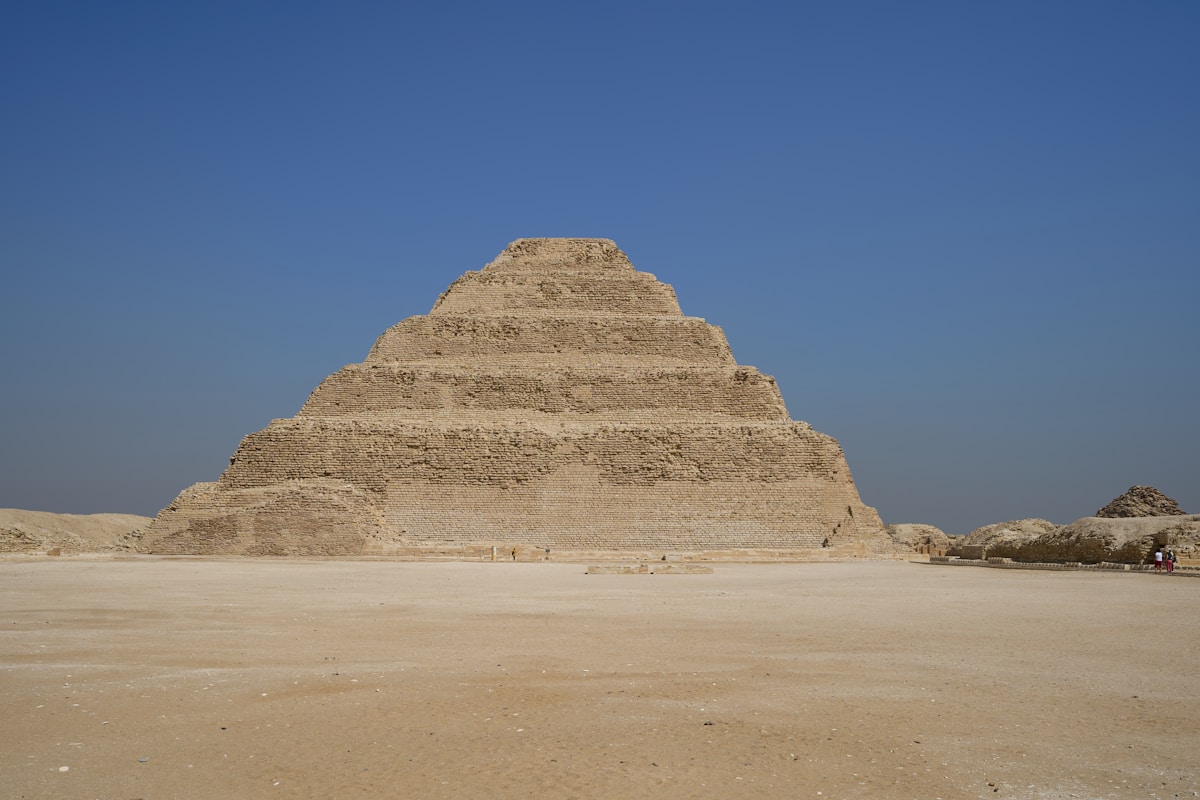
The Step Pyramid was built around 2650 BC for the Third Dynasty pharaoh Djoser by his chief architect and chancellor Imhotep. It stands 62 metres high in six stepped tiers and is the oldest large-scale stone monument ever constructed. Before it, monumental architecture used mud-brick; Imhotep’s innovation was to build in carefully cut limestone at a scale no one had attempted.
The design began as a mastaba - the flat-topped rectangular tomb form used for earlier royals and nobles - and was successively expanded and raised through multiple construction phases. The final form, the distinctive stepped silhouette, represents the transition from the mastaba tradition toward the smooth-sided true pyramid that would follow at Dahshur and Giza roughly a century later.
The Step Pyramid is surrounded by a complex of courts, shrines, and a mortuary temple, most of which are still under study. Ongoing restoration and excavation means access to certain structures varies.
Imhotep
Imhotep was not a pharaoh, but he achieved something almost no non-royal Egyptian managed: deification. During his lifetime he served as Djoser’s chancellor, high priest, and architect. Centuries after his death, he was venerated as a god of medicine and wisdom. Greek visitors to Egypt identified him with Asclepius, their own god of medicine - a remarkable cross-cultural equivalence that speaks to the persistence of his reputation. He is one of the earliest named architects or physicians in recorded history.
The Pyramid Texts and the Pyramid of Unas
The pyramid of Unas, built around 2345 BC near the end of the Fifth Dynasty, is externally small and unprepossessing - nothing like the scale of the Giza monuments. The interior is its significance. The burial chamber and antechamber walls are covered in vertical columns of hieroglyphic text: the earliest known Pyramid Texts, a corpus of religious spells, prayers, and instructions intended to guide the pharaoh safely through the afterlife.
These are the oldest known religious texts in the world. Later versions were expanded and adapted into the Coffin Texts (used by nobles) and eventually the Book of the Dead (available to anyone who could afford it). The interior of Unas’s pyramid is open to visitors and is worth seeing even for those with limited interest in Egyptology.
The Mastabas of the Old Kingdom Nobles
Saqqara contains dozens of mastaba tombs belonging to Old Kingdom officials, viziers, and administrators. Several are open to visitors, and the best contain detailed painted limestone reliefs depicting everyday life: fishing from papyrus boats, cattle being driven to market, craftsmen at work, scribes recording grain inventories. The mastaba of Ti and the mastaba of Kagemni are among the most detailed.
These scenes are not found at the Pyramids of Giza - the Giza complex is largely stripped of its original decoration. The Saqqara mastabas provide an irreplaceable visual record of how the Old Kingdom Egyptian elite lived.
Dahshur: The Precursor Pyramids
Twelve kilometres south of Saqqara sits Dahshur, containing two Fourth Dynasty pyramids that are almost entirely overlooked by tour itineraries despite their historical significance.
The Bent Pyramid (c.2600 BC) is immediately recognisable by its change of angle: the lower portion rises at one gradient, the upper section at a shallower one. The prevailing interpretation is that the angle was reduced mid-construction, possibly because the steeper gradient was causing structural instability. The exterior casing is the most intact of any pyramid in Egypt. The Red Pyramid, named for the reddish limestone used in its core, was completed at the shallower angle used for the upper portion of the Bent Pyramid - and is considered the first successful true smooth-sided pyramid.
Both pyramids predate Giza. Dahshur has almost no visitor infrastructure and receives only a fraction of Saqqara’s already modest numbers.
The Practical Day Trip
The standard itinerary combines Saqqara, Dahshur, and the Memphis open-air museum at Mit Rahina - the site of the ancient capital - into a single full day from Cairo. Memphis is largely unexcavated (much of it lies beneath the water table) but the open-air museum contains a colossal recumbent limestone statue of Ramesses II and a small alabaster sphinx.
A private driver for the day costs approximately EGP 600–1,200 from central Cairo. Public transport to Saqqara is possible but requires multiple connections and significant waiting time. For most visitors, hiring a driver is the practical choice for this itinerary.
See Also
- Pyramids of Giza - the later pyramid complex most travellers combine with Saqqara
- Dahshur and Memphis - the precursor pyramids at Dahshur and the ancient capital at Memphis
- Cairo Day Tours - guided tours that include Saqqara alongside the Giza plateau
- Cairo and Giza guided tours - browse day tours to Saqqara, Dahshur, and the Pyramids
- Cairo Travel Guide - where to base yourself for the Saqqara day trip
- Ancient Egypt History Overview - the Old Kingdom context for the Step Pyramid
- 3 Days in Cairo Itinerary - how to fit Saqqara into a short Cairo visit
Frequently Asked Questions
- Is Saqqara worth visiting if you've already seen the Giza Pyramids?
- Yes - they cover different periods and tell different stories. The Step Pyramid predates Giza by a century and the mastabas contain daily-life paintings not found at Giza. Saqqara is less crowded, the site is vast, and excavations continue to yield new discoveries.
- What is the Pyramid of Unas?
- The pyramid of Pharaoh Unas (c.2345 BC) at Saqqara contains the earliest known Pyramid Texts - a corpus of religious spells carved on the burial chamber walls intended to guide the pharaoh's journey to the afterlife. It is externally modest but the interior inscriptions are among the most significant texts from ancient Egypt.
Ready to explore?
Browse hundreds of tours and activities. Book securely with free cancellation on most options.
Browse on GetYourGuide →Best price guaranteed: same price as booking direct. We earn a small commission at no extra cost to you.