Karnak Temple Complex: Egypt's Largest Ancient Site
Book an experience
Guided historical tours
Walk through history with a local expert. Tours include skip-the-line access where available.
Karnak is the largest religious building ever constructed. The complex covers approximately 100 hectares - large enough that it functioned as a city within a city, with temples, pylons, courts, and sanctuaries added by successive pharaohs over roughly 2,000 years. Construction began around 2055 BC and continued into the Ptolemaic period. What visitors see today is a layered accumulation of building campaigns, each pharaoh typically adding a new pylon or hall at the front of the previous structure.
The Precinct of Amun-Re
The main accessible section is the Precinct of Amun-Re. The standard visitor route passes through the First Pylon - the massive gateway at the entrance, though at 43 metres high it remains unfinished compared to other pylons within the complex - and proceeds through a series of courts toward the inner sanctuary.
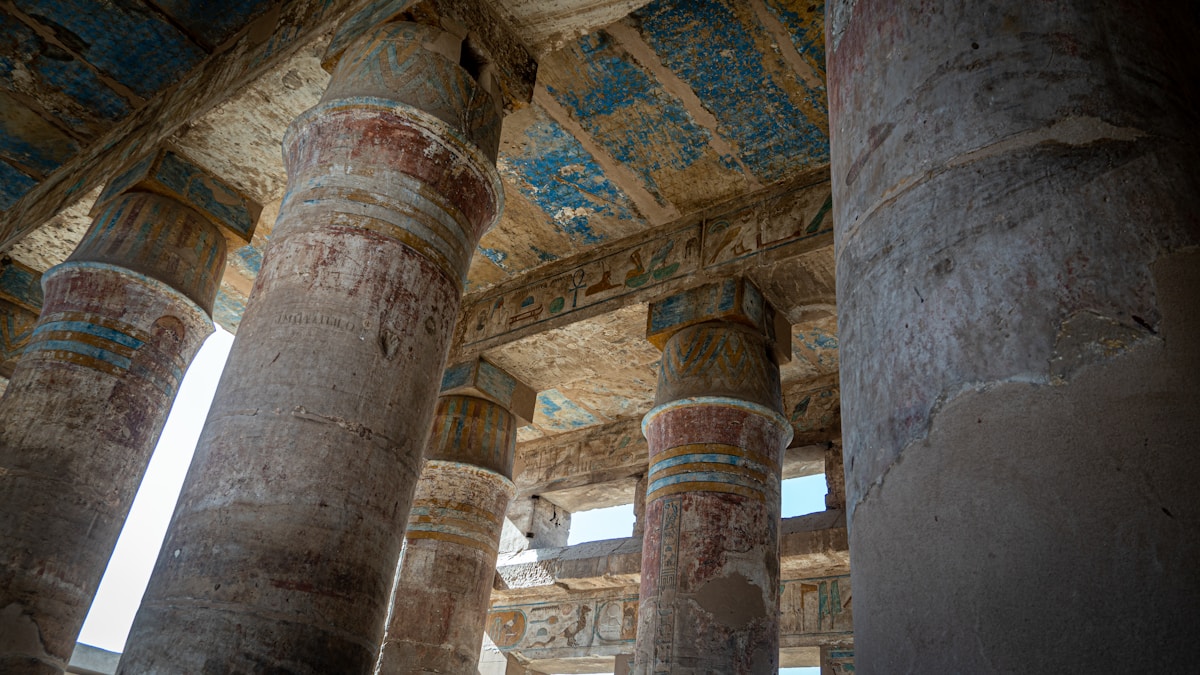
The Great Hypostyle Hall is the centrepiece. Its 134 sandstone columns are shaped to represent bundles of papyrus stems; the tallest columns in the central nave stand 21 metres high with capitals large enough to hold 50 people. The hall was originally roofed; clerestory windows along the central aisle allowed light to filter in. Traces of original painted relief carving survive on the upper reaches of many columns, away from centuries of weathering and human contact.
The Sacred Lake and Outer Precincts
The Sacred Lake is a large artificial reservoir to the south of the main temple. Ancient priests used it for ritual purification. It now serves as the centrepiece for the Sound and Light Show, with the illuminated pylons reflected in the water.
Two other precincts - of Montu (to the north) and Mut (to the south) - are part of the broader Karnak complex but have more limited access. The Precinct of Mut contains a large number of seated Sekhmet statues collected from various sites, but opening times vary and it is not always included in standard visits.
The Avenue of Sphinxes
A 2.7km processional road ran from Karnak south to Luxor Temple, lined with sphinx statues. Excavation and restoration of this avenue was completed relatively recently and it is now walkable - a straightforward and historically significant route between the two sites. Allow 40–50 minutes on foot. The avenue passes through parts of modern Luxor town, which adds an odd but interesting contrast between the ancient roadway and everyday urban life.
The Sound and Light Show
The show runs nightly in multiple languages; check the current schedule and language options at the ticket office or via your hotel. The theatrical narration speaks in the voice of the pharaohs, which is an acquired taste, but the illumination of the pylons and hypostyle columns is genuinely impressive. It is also a useful way to understand the spatial layout of the complex - which can be disorienting during the day - because the show guides you physically through the site in sequence.
Getting There from Luxor
Karnak is approximately 3km north of central Luxor. A taxi or tuk-tuk from Luxor town takes five to ten minutes; the walk along the Corniche takes 30–40 minutes in cooler weather and is pleasant in the early morning or evening. The site opens early - 6am in summer - making it one of the better options for a dawn visit before temperatures rise.
Combining Karnak with Luxor Temple
If you have a full day on the East Bank, visiting Karnak in the morning and walking the Avenue of Sphinxes to Luxor Temple in the late afternoon is a natural combination. Luxor Temple is also illuminated at night and has no separate Sound and Light Show fee, making a second evening visit straightforward.
For the full picture of Luxor - accommodation, restaurants, and transport between East and West Bank - see our Luxor city guide. The West Bank counterpart to Karnak is the Valley of the Kings and Hatshepsut Temple, both covered in dedicated guides.
See Also
- Medinet Habu: Temple of Ramesses III - another major West Bank temple, often less crowded than the Valley of the Kings sites
- Deir el-Medina: The Workers’ Village - the community of craftsmen who built the royal tombs
- Luxor West Bank Tours - guided tours covering the main West Bank circuit
- Hot Air Balloon Luxor - early morning balloon flights over Karnak and the West Bank
- Luxor Itinerary - how to plan a multi-day visit to East and West Bank
- Ancient Egypt History Overview - context for Karnak’s role in New Kingdom religious life
- Luxor tours and guided excursions - browse Karnak and East Bank guided tours
Frequently Asked Questions
- How long does Karnak take to visit?
- Allow at least 2 hours for the main Precinct of Amun-Re. Budget 3–4 hours if you want to explore thoroughly, including the other precincts that are accessible.
- What is the Great Hypostyle Hall?
- A forest of 134 massive papyrus-shaped sandstone columns in the Precinct of Amun-Re. The hall was once fully roofed; parts of the original painted decoration survive on the upper column shafts. It is the most photographed element of the complex.
- Is the Sound and Light Show at Karnak worth attending?
- It is a useful way to orient yourself to the site's layout at night, and the illumination is impressive. The narration is theatrically dated. Worth attending if you have a free evening in Luxor.
Ready to explore?
Browse hundreds of tours and activities. Book securely with free cancellation on most options.
Browse on GetYourGuide →Best price guaranteed: same price as booking direct. We earn a small commission at no extra cost to you.