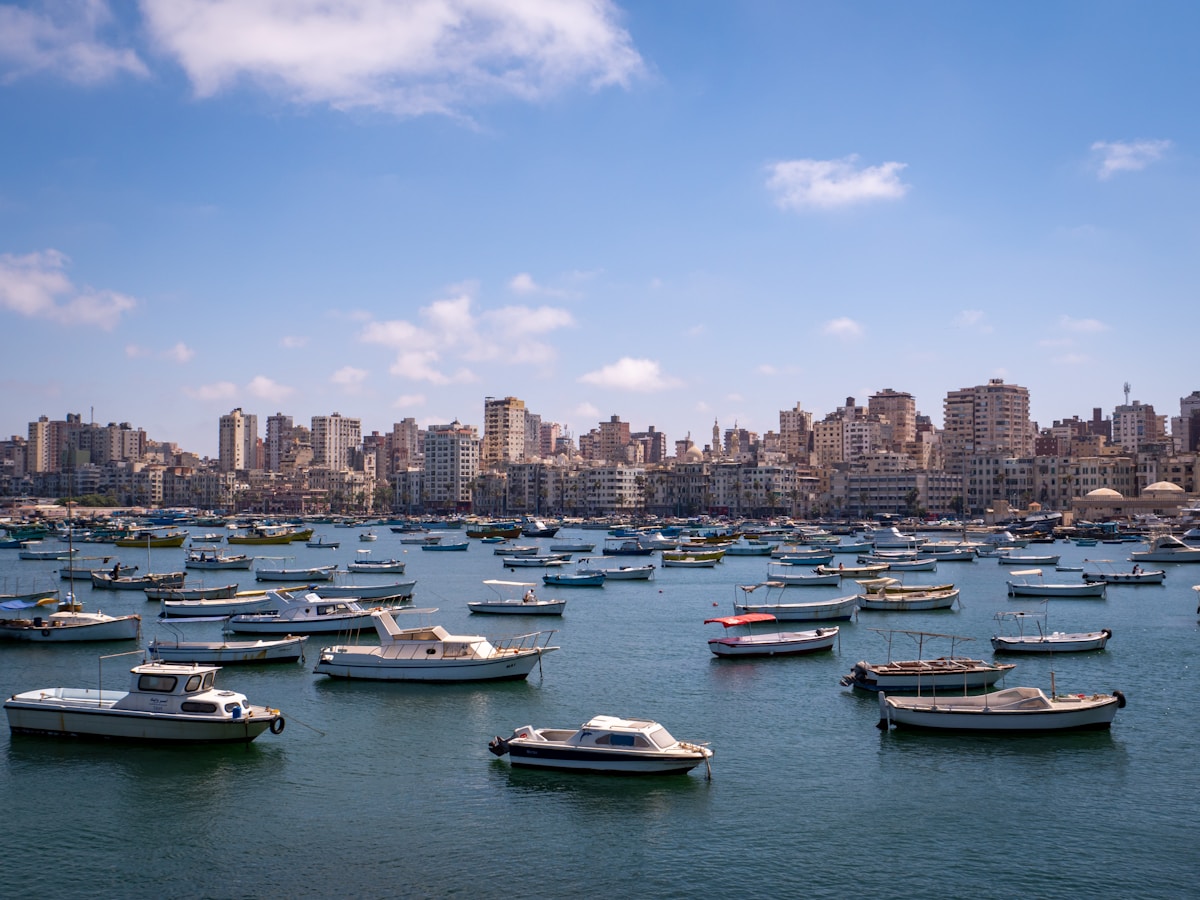
Alexandria Travel Guide: Egypt's Mediterranean City
Plan your trip to Alexandria - Bibliotheca Alexandrina, Qaitbay Citadel, Roman catacombs, seafood, and the Mediterranean coast.
Guides for Alexandria
Alexandria was founded by Alexander the Great in 331 BCE and became the capital of Ptolemaic Egypt and one of the ancient world’s greatest cities. The ancient library, the Lighthouse of Pharos, and the royal quarter made it a centre of learning and commerce. Most of that ancient city is now underwater or buried beneath the modern one - but the layers are visible if you know where to look, and the city retains a character markedly different from anywhere else in Egypt.
Bibliotheca Alexandrina
The Bibliotheca Alexandrina opened in 2002 as a modern successor to the ancient Library of Alexandria, which was destroyed in antiquity under circumstances that remain historically disputed. The building itself - a tilted disc facing the sea - is architecturally striking. Inside it functions as a genuine working library and cultural centre, with several museums: the Manuscript Museum, the Antiquities Museum (with objects from the seafloor of Alexandria’s harbour), and a planetarium. Allow two to three hours if you explore the museums properly.
Qaitbay Citadel
The Citadel of Qaitbay stands on the narrow strip of land at the entrance to the Eastern Harbour, built in 1477 by the Mamluk Sultan Qaitbay on the site of the ancient Lighthouse of Alexandria - one of the Seven Wonders of the Ancient World. Stones from the collapsed lighthouse were incorporated into the fortress walls. The citadel gives good views over the harbour and the Corniche, and the interior displays on its history are worth reading. Entry is inexpensive.
Kom el-Shoqafa Catacombs
The Catacombs of Kom el-Shoqafa date to the 2nd century CE and are the largest known Roman funerary complex in Egypt. Three levels of tombs are cut into the bedrock, the lowest now partially flooded. The decoration is a deliberate fusion of Egyptian and Roman artistic traditions - pharaonic motifs rendered in a Roman sculptural style, which reflects Alexandria’s mixed cultural world at the time. The site was described in the medieval period as one of the Seven Wonders of the Middle Ages. It is easy to underestimate how impressive it is from the outside; the interior is genuinely remarkable.
The Corniche and Stanley Bridge
Alexandria’s Corniche stretches 20km along the Mediterranean waterfront from the Eastern Harbour in the east through Stanley and out toward Montaza. Stanley Bridge, an arched pedestrian and road bridge at the Stanley Bay area, is the city’s most photographed modern landmark. The beach culture along the Corniche is largely a summer phenomenon - from June through August, Alexandrian beaches fill with Egyptian families escaping Cairo’s heat. Outside those months, the waterfront is quieter and easier to walk.
Montaza Palace, at the northeastern end of the Corniche, is a late Ottoman-era royal residence set in large gardens. The gardens are open to the public; the palace itself is not. The seafront here is less crowded than central Alexandria.
Food in Alexandria
Seafood is central to eating in Alexandria, reflecting the city’s position on the Mediterranean. Fresh fish restaurants along the harbour - particularly in the Anfushi neighbourhood - operate on a simple formula: choose your fish at the counter by weight, specify how you want it cooked. Prices are reasonable compared to Cairo restaurants. The city also has a strong breakfast culture built around ful (slow-cooked fava beans) and ta’ameya (the Egyptian equivalent of falafel, made with fava beans rather than chickpeas).
Greek and Italian communities shaped the city’s bakery and pastry culture in the 19th and early 20th centuries; some of that influence survives in the city’s older patisseries, though the community itself is largely gone.
Want to explore the city with a local guide? Browse Alexandria tours and day trips for walking tours, catacombs visits, and harbour excursions.
Getting There from Cairo
Alexandria is approximately 220km northwest of Cairo along the Nile Delta. The most convenient option is the air-conditioned express bus (operated by Go Bus and others) from Cairo’s various departure points - the journey takes around 2.5 hours and is comfortable. Trains also run frequently from Ramses Station in Cairo to Alexandria’s Misr Station; express services take 2–2.5 hours. Domestic flights exist but are impractical given the short distance and airport transfer times at both ends.
When to Visit
May through October is the warmest period, with Mediterranean temperatures of 25–30°C and an active beach scene in summer. Winters are mild by Egyptian standards - 15–20°C - but Alexandria gets notably more rain than anywhere else in Egypt (it averages around 200mm per year, mainly November through February). The city is less crowded in winter and the main sites are easier to visit without the summer beach crowds.
Alexandria Guides
- Things to Do in Alexandria
- Getting to Alexandria
- Where to Stay in Alexandria
- Alexandria Seafood Guide
- Food to Try in Alexandria
- Cairo vs Alexandria: Which to Visit?
- Cairo Travel Guide - the most common starting point for an Alexandria side trip
- 2 Weeks in Egypt Itinerary - Alexandria fits naturally into a two-week circuit
Book an experience
Top experiences in Alexandria
Explore the best tours and activities in Alexandria , with instant confirmation and free cancellation on most bookings.